
Insights
Group captive turns on two numbers.
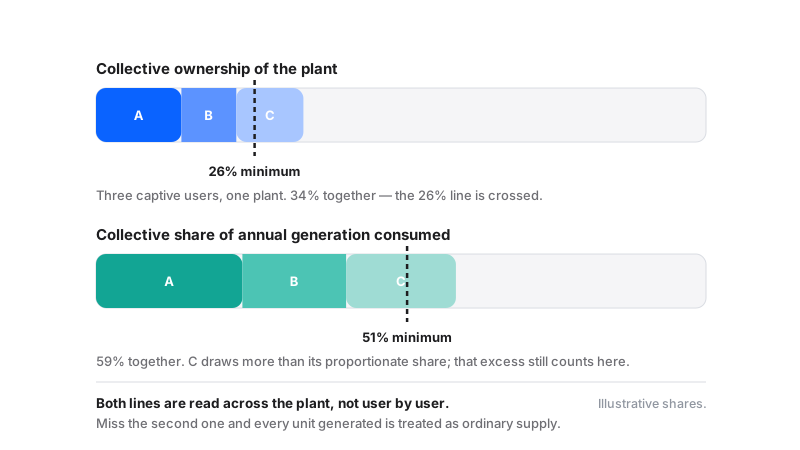
Captive is not a cheaper tariff. It is a test, and since the 2026 amendment it is a test on the plant rather than on each shareholder in turn. Two numbers decide it, and both are counted across everyone together.
The attraction is easy to state. Power a company consumes from its own captive plant is not subject to cross-subsidy surcharge or additional surcharge — charges that, on an open-access contract, can move a delivered tariff by more than the generation cost the negotiation was about. That is why so many industrial offtake structures are written as group captive rather than as a straight power purchase.
The charges are set aside only while the structure actually qualifies. Miss the test and they come back — on everything, for everyone in the structure, not just on the user who slipped.
The two thresholds
| Test | Threshold | Measured on |
|---|---|---|
| Ownership | At least 26% | The captive users’ combined equity or ownership interest in the plant. |
| Consumption | At least 51% | The captive users’ combined share of the plant’s annual generation. |
Both are read collectively. Not 26% each, and not 51% each — 26% and 51% between them, added up across every captive user in the structure. That word is the whole of the 2026 change, and it is worth being precise about what it replaced.
What “collective” replaced
The earlier reading tested each shareholder individually against a proportionate floor — a unitary qualifying ratio of roughly 1.96%, derived from the way the courts had read the two conditions together. Every captive user had to clear it on its own.
The practical consequence was that the structure was only ever as sound as its least disciplined member. One consumer whose production fell, or whose site shut for a quarter, could miss its individual target and take the plant’s captive status down with it — for every other user in the structure, none of whom had done anything wrong.
Three things changed.
- The floor became collective. The plant is tested once, on combined ownership and combined consumption, instead of user by user.
- The risk became contained. A user drifting off its own share is now a question about that user’s own units, not an existential one for the plant.
- A corporate group counts as one user. A holding company, its subsidiaries and the other subsidiaries of that holding company are read as a single captive user, for ownership and for consumption alike.
Three consumers, one plant
The mechanics are easiest to see with a structure that is not uniform — which is to say, with a real one.
| Consumer A | Consumer B | Consumer C | |
|---|---|---|---|
| Ownership | 26% or more. | Less than 26%. | Less than 26%. |
| Consumption | Whatever it draws. | Within its proportionate share. | More than its proportionate share. |
| Result | Qualifies as captive. Holding 26% or more in its own right, its entire consumption is captive — no proportionate restriction applies to it. | Counts as captive. | Permitted. The excess above its share is treated as supply by a generating company, and the surcharges apply to that excess alone. |
The part worth reading twice
Consumer C’s excess is still counted towards the plant’s collective 51%. One user drawing more than its share costs that user something on the excess; it does not put A and B at risk. Under the old individual test, it might have.
What still breaks it
Collective is not the same as forgiving. Three things still end captive status, and the first is the one that matters most.
- Missing the collective 51%. If the captive users together consume less than 51% of what the plant generated over the year, the entire generation is treated as supply by a generating company. The surcharges apply to all of it, for every user — including the ones who consumed exactly what they promised. This is the cliff, and it is a cliff rather than a slope.
- Failing verification. Captive status is verified, not assumed. Pending verification the surcharges are not levied where the prescribed declaration has been filed; if verification then fails, they become payable, with carrying cost. A structure that was never going to qualify does not simply stop — it bills backwards.
- An SPV doing anything else. Where a special purpose vehicle owns the plant, it is treated as an association of persons and has to exist solely to own, operate and maintain that plant. No other business activity.
What this piece is and is not
An explanation of the mechanics, written for people sizing and pricing projects. It is not legal advice, and it is not a substitute for reading the instrument: the Electricity Act, 2003 and the Electricity (Amendment) Rules, 2026, notified 13 March 2026. The percentages on the cover are illustrative. Anything with a surcharge attached to it should be confirmed with counsel before it reaches a term sheet.
Why this is a modelling question
The 51% test is annual and it is about energy, not intent. Whether a structure clears it is a function of how much the plant generates and how much the captive users actually draw, hour by hour, across a year that has not happened yet.
Both halves move. Generation moves with resource: a P90 year is not a P50 year, and the gap between them is exactly the kind of margin a structure sized to 52% does not survive. Consumption moves with the offtakers’ own load — shutdowns, shift patterns, a plant running below nameplate. A structure that clears 51% on a spreadsheet of annual averages can miss it in a poor wind year while every party behaves exactly as promised.
Which is why it belongs in the simulation rather than in a footnote. Run the year, add up what the captive users actually take, and see where the ratio lands — and then see where it lands in the bad year, not just the central one. The question to answer before signing is not “does this clear 51%?” but “how much room is there above 51%, and what does it take to lose it?”