
Insights
Delay now has a price list.
A connectivity slot used to be something you either kept or lost. Miss a milestone and it was revoked; the only way back was a petition. Since 14 August 2026 there is a third answer, and it is a price.
Connectivity is the scarce thing. Not land, not modules, not even money — a grant of connectivity at a substation with headroom is what turns a site into a project, and there is not enough of it to go round. Which is why holding a slot you are not yet using has always been contentious, and why the consequence of falling behind was so blunt: the grant went away.
Milestone Extension Charges replace that cliff with a meter. A developer who qualifies can buy more time on a milestone by paying for it, per MW, per day — and the proceeds go to reducing monthly transmission charges for everyone else under the Sharing Regulations, 2020. The slot is still scarce; you now pay the people waiting for it.
What actually changed
Under the General Network Access Regulations, 2022, missing any of the three milestones — land documents, financial closure, commercial operation date — meant revocation. Relief existed, but only case by case, on a petition to the Commission. That is a slow, uncertain and public way to ask for something, and it made delay a binary risk rather than a cost.
The order turns it into a standing route. An eligible developer does not need to argue; they need to pay, and to file on time.
The three milestones
| Land documents | Financial closure | Commercial operation | |
|---|---|---|---|
| Who qualifies | Land documents for at least 20% of the required land, per the connectivity draft. | Land documents for at least 20% of the required land, per the connectivity grant. | Land for 75% of the requirement on the Land or Land BG route, or 50% on the LoA or PPA route — plus executed contracts for major equipment and for civil and electrical works. |
| Maximum extension | 3 months | 6 months | 12 months |
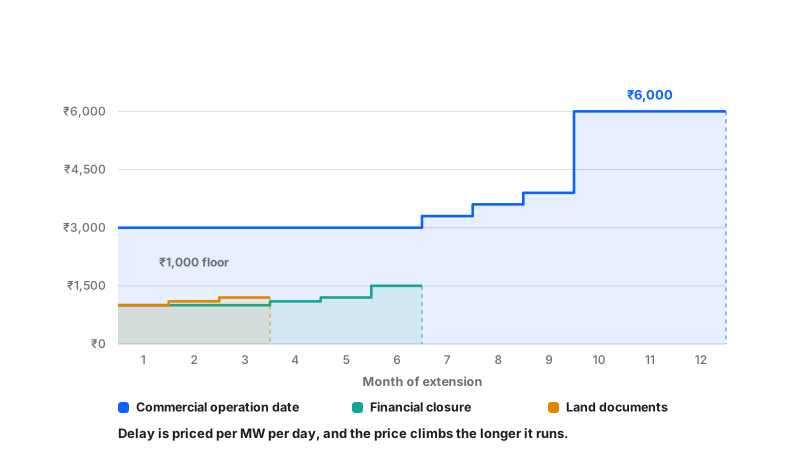
| Cost, per MW per day | ₹1,000 for the first month, then ₹1,100 and ₹1,200. | ₹1,000 for months 1–3, then ₹1,100, ₹1,200 and ₹1,500. | ₹3,000 for months 1–6, then ₹3,300, ₹3,600 and ₹3,900 — and ₹6,000 for months 10–12. |
| If you still miss it | Connectivity is revoked. | Connectivity is revoked. | Revoked for the capacity that has not achieved COD. |
Filing is not an afterthought: the documents have to be in at least 15 working days before the compliance deadline. A developer who decides to extend on the last morning has already missed the window to do it.
What that adds up to
On a 100 MW project, taking the commercial operation date out by the full twelve months costs about ₹14 crore at 30-day months — roughly ₹90 lakh a month for the first six, and ₹1.8 crore a month for the last three. The final quarter costs twice what the first six months did, month for month. That is the shape of the thing: the tariff is designed to make a short slip affordable and a long one painful.
What the money does not buy
Three limits, and each one is the kind of assumption that quietly finds its way into a model.
- It is not a tariff pass-through. MEC is not a Change in Law event. The cost stays with the developer, and neither the connectivity start date nor the payment obligations move.
- It is not a PPA reset. Liquidated damages and every other consequence under the power purchase agreement carry on exactly as written. Buying time from the transmission side does not buy time from the offtaker.
- It is not conditional on fault. The charge is payable whatever caused the delay, including causes outside the developer’s control. There is no argument to be had about whose fault it was, because the rate does not ask.
What works in the developer’s favour
- Half comes back if you finish on time. Reach COD without needing a COD extension and half the MEC paid on the land and financial closure milestones is returned. On a 100 MW project that had maxed both, that is roughly ₹1.5 crore of the ₹3 crore paid.
- Unused time is refunded. MEC is paid at least fifteen days in advance. Meet the milestone early and the unused portion comes back — without interest, but it comes back.
- A grace period at the start. Where revocation would be triggered immediately after GNA effectiveness, a two-month grace period applies with no MEC.
About this piece
An explanation of the mechanics, written for people sizing and pricing projects, and drawn from the CERC order dated 14 August 2026 in Petition No. 5/SM/2026. It is not legal advice and it is not a substitute for the order itself, which is published at cercind.gov.in. The worked figures assume 30-day months and are illustrative.
Why this belongs in the model
Before the order, schedule risk was hard to put in a financial model because its consequence was not a number. Losing connectivity does not have a rupee value; it ends the project. So it tended to sit in a risk register as a paragraph, and the model carried on assuming the dates held.
Now it is a number, and a steeply non-linear one. Two months late and three months late are not the same kind of problem, and twelve months late costs more than twice what six months costs. That is exactly the sort of curve a model should be carrying, because it changes what a sensible schedule buffer is worth.
It also changes some decisions that used to look obvious. Ordering long-lead equipment early has a carrying cost; so does not ordering it. Once delay is priced per MW per day, the two can be compared on the same axis instead of argued about. The same goes for oversizing a connection, for choosing between the Land and LoA routes, and for how much contingency belongs in the construction programme.
The useful question is not “will we be late?” It is: if we are late, by how much, and what does each additional month cost against what it saves elsewhere? That is arithmetic, and it is worth doing before the schedule is fixed rather than after.