
Insights
A project has a configuration, not a size.
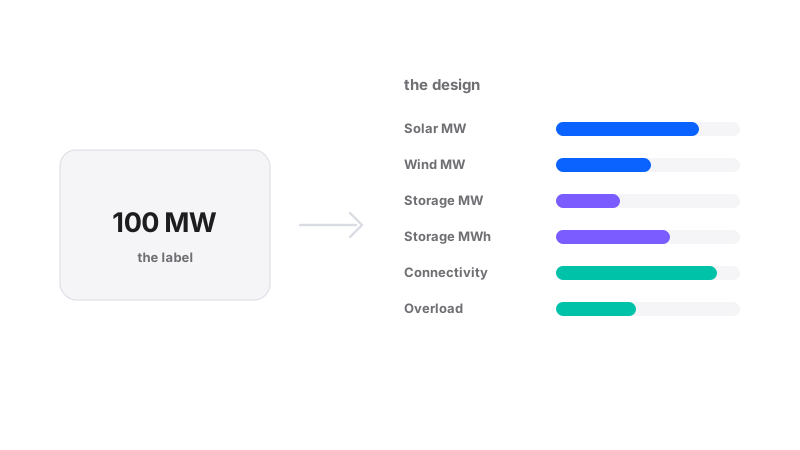
“100 MW solar” is a procurement label, not a design. The design is six numbers, and each one moves generation, cost and tariff independently of the others.
Ask two teams to price a 100 MW project and you will get two different answers, not because one of them is wrong but because they have quietly designed two different plants. The label they were both given fixes almost nothing.
What actually fixes a project is a set of six numbers. Change any one and the energy the plant delivers, the capital it consumes and the tariff it can support all move — and they do not move together.
The six numbers
| Number | Unit | What it decides |
|---|---|---|
| Solar AC | MW | What the inverters can push out at any instant. This is the number that meets the grid. |
| Solar DC | MWp | How much panel is behind those inverters. Sets the shape of the generation curve, not its ceiling. |
| Wind | MW | Capacity on a different resource, with a different daily and seasonal shape from solar. |
| BESS power | MW | How fast the battery can charge or discharge. Decides whether a peak obligation can be met at all. |
| BESS duration | hours | How long it can hold that rate. Power × duration is the energy, and the two are not interchangeable. |
| Overloading factor | DC/AC | The ratio of the first two. A design choice about how much clipping you accept in exchange for a fuller curve. |
Notice that two of the six are ratios or products of the others. That is deliberate. Overloading and duration are the two numbers most often left implicit, and they are the two that most often explain why one bid is cheaper than another.
Why the label is not enough
A round-the-clock obligation makes the point quickly. Suppose the contracted capacity is 100 MW and the offtaker wants it delivered across most of the day. Here are two configurations that both answer to “100 MW”:
| Configuration A | Configuration B | |
|---|---|---|
| Solar AC | 140 MW | 140 MW |
| Solar DC | 196 MWp | 252 MWp |
| Overloading | 1.40 | 1.80 |
| Wind | 90 MW | 90 MW |
| BESS | 60 MW / 4 h | 60 MW / 4 h |
Only one number differs. But B has forty percent more panel behind the same inverters. It generates more in the shoulders of the day, which is exactly when a firm obligation is hardest to meet, and it throws away more at noon, when the inverters are already saturated. Whether that trade is worth paying for depends entirely on the delivery profile in the contract — and cannot be answered from the label at all.
The configuration card
Write your project down like this before you model anything. The point is not the specific values; it is that a reader can compare this against another project without asking a single follow-up question.
| Illustrative 100 MW RTC case | Value |
|---|---|
| Contracted capacity | 100 MW |
| Connectivity | 120 MW |
| Solar AC | 140 MW |
| Solar DC | 196 MWp |
| Overloading factor | 1.40 |
| Wind | 90 MW |
| BESS power | 60 MW |
| BESS duration | 4 hours |
| BESS energy | 240 MWh |
Two entries here are not among the six but belong on any card: contracted capacity, because every obligation is measured against it, and connectivity, because the difference between the two is the headroom you have to export anything above the contract. If connectivity equals contracted capacity, there is none.
About the numbers here
Every figure in this piece is illustrative. They are internally consistent so the arithmetic can be followed end to end, but they are not drawn from any real project, tender or client.
What to do with it
- Fill the card in for your own project. If you cannot fill a row, that is the row to settle first.
- When someone quotes a tariff, ask for their card. A tariff without a configuration is not comparable to anything.
- When a number changes, change one at a time. Moving overloading and duration together tells you the answer moved; it does not tell you which one moved it.
The rest of this series builds on this vocabulary. The next piece takes three numbers that get used as if they were interchangeable — and are not.