
Insights
CUF, PLF and availability are three different numbers.
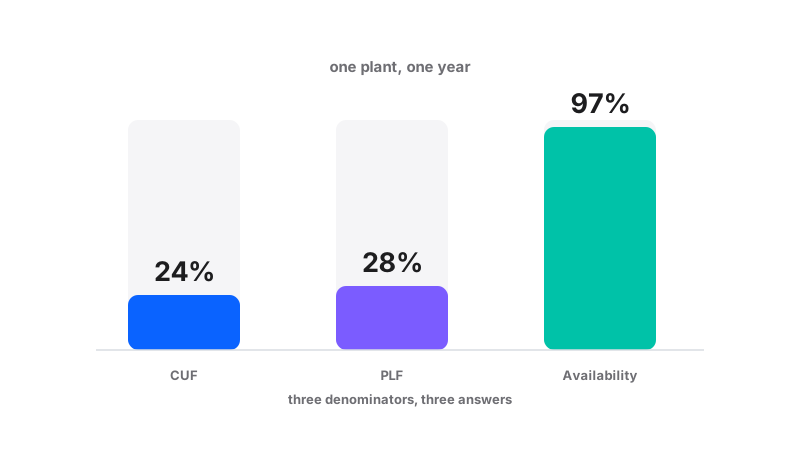
CUF, PLF and availability get quoted as if they were the same idea at different resolutions. They have different denominators and different contractual consequences, and only one of them usually carries a penalty.
The confusion is understandable. All three are percentages, all three describe “how well the plant did”, and in casual conversation they are swapped freely. In a contract they are not interchangeable at all, and the difference between them is the difference between a comfortable year and a penalty.
Three numbers, three denominators
Every one of them is energy or time divided by something. The something is what separates them.
| What it measures | Denominator | |
|---|---|---|
| CUF Capacity Utilisation Factor |
Energy actually generated over a period. | The energy the plant would have produced running flat out for the whole period. |
| PLF Plant Load Factor |
The same energy, but judged against what the plant is rated to do. | Rated output across the period being measured. |
| Availability | Whether the plant was ready to deliver. | Hours in the period — whether or not the sun or wind showed up. |
That last row is the one that surprises people. Availability is not a measure of output. A solar plant at midnight is unavailable in no meaningful sense — it is simply night. A well-drafted availability clause excludes the hours when the resource was never there, and measures only whether the machine would have delivered if it had been.
The same plant, scored three ways
Take one illustrative asset over one year and score it under each definition. Nothing about the plant changes between the rows. Only the question does.
| Measure | Result | Reading |
|---|---|---|
| CUF | 24% | Roughly what a well-sited solar asset delivers against its own capacity across a year. |
| PLF | 28% | Higher, because the denominator is the rated output over the period rather than a full-capacity year. |
| Availability | 97% | The equipment was ready almost all of the time it was asked to be. The 3% is outage, not weather. |
All three numbers are true at once, for the same asset, in the same year. Quoting one and calling it another is not a rounding difference; it is a different claim.
About the numbers here
Every figure in this piece is illustrative. They are internally consistent so the arithmetic can be followed end to end, but they are not drawn from any real project, tender or client.
Which one the penalty attaches to
This is the part that matters commercially. A tender will usually pick one of the three and build its penalty on that, and the choice tells you what the offtaker is actually buying.
- A declared CUF obligation asks you to commit to an energy number. You are carrying resource risk: a poor wind year is your problem, not theirs.
- An availability obligation asks you to commit to being ready. You are carrying equipment and operations risk, and the resource is excluded. These are the constructs where storage earns its place.
- PLF rarely carries the penalty directly. It tends to appear inside the model — as the trigger for battery augmentation, for instance — rather than inside the contract.
The question to ask of any obligation
Before modelling anything: what is the denominator, and who owns the risk in it? If the denominator contains weather, you are being asked to underwrite weather. If it contains only hours, you are being asked to underwrite your own machines.
The next piece is about a related confusion — not between three measures, but between two versions of the same one.