
Insights
100 MW of firm power needs about 300 MW built.
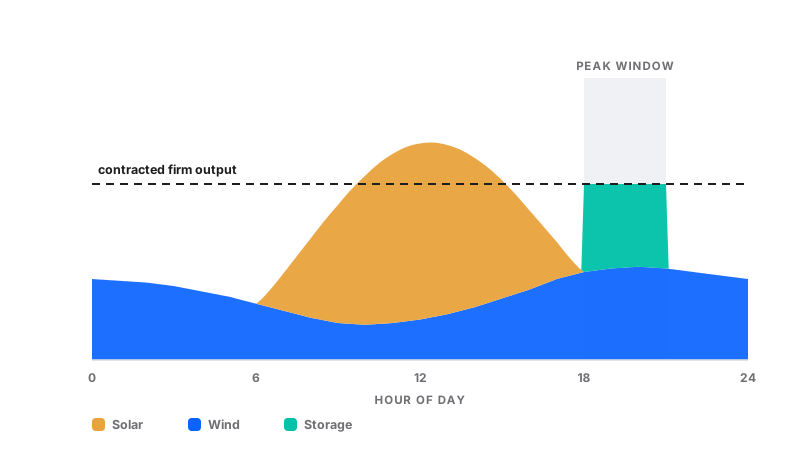
FDRE and RTC do not buy energy. They buy a shape — a level of output, inside a window, with a penalty attached. Meeting a shape with sources that come and go is what makes the build so much larger than the contract.
A tender for 100 MW of firm renewable power is not a tender for 100 MW of plant. The number in the contract is what has to arrive at the meter; the number on the ground is whatever it takes to put it there. Those two are usually a factor of three apart, and a model built on the first one is not conservative — it is describing a project that cannot be built.
The two constructs
FDRE is firm and dispatchable renewable energy: power committed at a stated level inside a defined window each day. RTC is round the clock: the same idea stretched across all twenty-four hours. They are different obligations, and they produce different plants.
| Parameter | FDRE (peak) | RTC (24/7) |
|---|---|---|
| Delivery window | A defined window each day, usually the evening peak. | Every hour of every day. |
| Availability commitment | High, but only inside the window. | High annually and within each time block. |
| Capacity utilisation | Lower — only the window hours are counted. | Higher — the obligation is spread across the day. |
| What it replaces | Evening peaking capacity. | Baseload, for C&I and utility offtake. |
The distinction that matters commercially is the second row. An annual availability figure and a block-wise one are not the same promise, and a plant sized against the first will miss the second in exactly the hours the tender cares about.
Why the build is a multiple of the contract
Three facts, and the arithmetic follows from them.
- Average output is not the binding number. Solar in India runs at roughly a 20–25% CUF and wind at roughly 30–35%, but you are not paid on the average. You are paid on the worst hours inside the window, and the plant has to be sized against those.
- Storage shifts hours, not seasons. A battery is limited in power and in duration. Two to four hours of discharge covers a peak window; it does not cover a still, overcast week. Storage makes the window deliverable, and generation has to make the storage fillable.
- Solar and wind fail at different times. That is the reason to build both. Wind carries the night and the shoulders; solar carries the middle of the day and charges the battery for the evening. Neither alone gets to a firm line at a sane cost.
Put together: solar sized well above what the daytime load needs, wind sized to hold the shoulders and the night, storage sized to top the stack up to the contracted line for the length of the window. Total installed capacity typically lands somewhere around two and a half to three and a half times the contracted figure. A 100 MW firm commitment is a 250–350 MW build.
The number that is not the build
Contracted capacity is the promise. Installed capacity is what the promise costs. Reading a tender’s headline megawatts as the plant size understates capex by roughly a factor of three, and every derived number — land, evacuation, debt, tariff — inherits the error.
One day, walked through
The cover of this piece is a single illustrative day. It is worth reading hour by hour, because the shape explains the sizing.
- Overnight. Wind alone, and it sits below the contracted line. Outside the window that is allowed — nothing was promised there.
- Morning into noon. Solar climbs and the stack crosses the line. Everything above it is surplus: stored if there is room and headroom in the connection, exported if there is not, and clipped if there is neither.
- Evening window. Solar has gone, wind is doing what wind does, and the battery discharges to hold the line for the contracted hours. This is the only place in the day where the commitment actually binds.
- After the window. Storage is spent and output drops back under the line. Again, permitted — the window has closed.
An RTC construct removes the third and fourth bullets as separate cases: the line has to be held everywhere, which is why RTC plants carry more storage and more generation than an FDRE plant of the same contracted size.
What moves the ratio
Two and a half to three and a half is a range, not a rule. What decides where you land:
- Site resource. A better wind regime does more of the work overnight and takes megawatts out of the build. This is the single largest lever.
- Storage duration. Two hours against four changes how much solar you need to charge it, and how much of the window it can actually cover.
- Window length. A three-hour peak obligation and a six-hour one are different plants.
- How availability is measured. Annual, monthly or per time block — the tighter the measurement, the less the good months can carry the bad ones.
- The connectivity cap. If connectivity equals contracted capacity, the midday surplus has nowhere to go, and oversizing stops paying before it stops being necessary.
- The penalty. Oversizing is bought against the cost of falling short. A hard penalty justifies capacity that a soft one does not.
About the numbers here
The ratios and CUF ranges in this piece are illustrative and typical rather than drawn from any particular project, tender or client. The dispatch profile on the cover is a single stylised day, not a metered one. The point is the shape of the argument; the actual ratio comes out of the model.
Where the model earns its place
None of the above is settled by judgement. The ratio is the answer to an optimisation: simulate every hour of a full year, across thousands of combinations of solar MW, wind MW, storage MW and storage MWh, and find the cheapest combination that still meets the commitment with the availability the tender demands.
Do it on averages and the plant is undersized in exactly the hours that carry the penalty. Do it on the worst hour and the plant is unfinanceable. The configuration that wins the bid sits between those two, and finding it is arithmetic, not instinct.