
Insights
Reading a tender as a set of constraints.
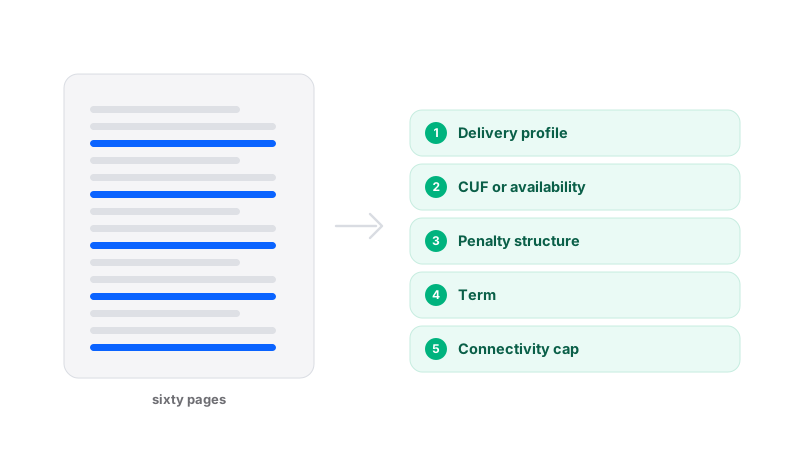
A bid document runs to sixty pages. About five numbers in it fix your configuration. Everything else is procedure — and the order you extract them in decides how much work you waste.
The instinct on receiving a tender is to read it front to back and start modelling. That is the slowest route, because the document is not organised around the decisions you have to make. Procedure, eligibility and submission mechanics take up most of the pages and constrain nothing about the plant. A handful of clauses constrain everything.
The five that fix the configuration
| Extract | Because it fixes |
|---|---|
| 1. The contracted delivery profile Which hours, at what level, in which months. |
Storage power and duration. A peak-window obligation and a round-the-clock obligation produce completely different batteries. |
| 2. The CUF or availability obligation And crucially, which of the two it is. |
Whether you are underwriting weather or your own machines. It decides how much margin the configuration needs. |
| 3. The penalty structure The multiplier, the measurement window, and the cap if there is one. |
What a shortfall costs. This turns a technical miss into a number, and it is what oversizing is bought against. |
| 4. The term PPA length, and what happens after it. |
Debt tenor, augmentation planning, and whether there is a merchant tail worth modelling. |
| 5. The connectivity cap Against contracted capacity. |
Your over-injection headroom. If the two are equal, surplus has nowhere to go and overloading stops paying. |
Five numbers. With them you can size a configuration. Without any one of them you are guessing, and a model built on a guess in one of these five is not conservative — it is simply describing a different project.
The extraction checklist
In this order, before opening a model at all.
- Delivery profile first. Everything downstream depends on it. Write out the hours and the required level per month; if the document expresses it as a table, copy the table rather than summarising it.
- Then the obligation, and name it correctly. Establish whether it is CUF, availability, or a block-wise demand ratio. Do not accept the word the document uses for it — check the denominator in the definition.
- Then the penalty. Multiplier, window, and cap. Note whether the window is monthly, annual, or per time block, because the same shortfall costs different amounts under each.
- Then the term and the tail. PPA years, and whether the asset has a life beyond it that anyone is allowed to monetise.
- Then connectivity against contracted capacity. Subtract one from the other and write the headroom down explicitly.
- Only then open the model. Fill the configuration card from the previous articles. If a row is still empty, the answer is in the tender and you have not found it yet.
The most common extraction error
Taking the obligation’s name at face value. Tenders use “availability” for things that are measured like a CUF, and vice versa. The definition clause governs, not the heading — and the difference decides whether the resource risk is yours.
Between them these six pieces cover the vocabulary, the measures, the statistics, the failure modes, the arithmetic and the document — which is most of what a first bid needs and almost none of what it usually gets. The last piece puts them to work on the construct that asks the most of all of them.