
Insights
Curtailment means four different things.
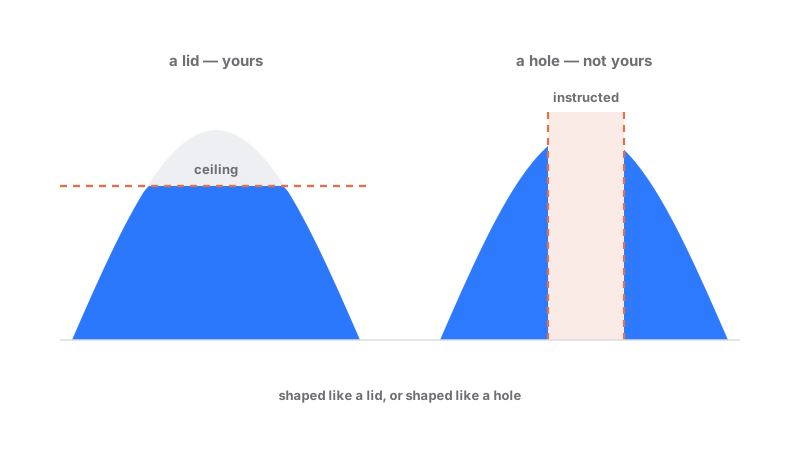
Inverter clipping, an evacuation cap, a grid instruction and contractual curtailment are four different events with four different owners and four different remedies. Only one of them is anyone’s fault.
“We were curtailed” is a sentence that ends an investigation prematurely. It describes a symptom — energy that could have been generated and was not exported — and says nothing about the cause. The four causes are unrelated to one another, and confusing them produces the wrong claim against the wrong party.
The four
| Cause | Where it happens | Whose it is |
|---|---|---|
| 1. Inverter clipping | Inside the plant, between the panels and the inverters, when DC generation exceeds what the inverters can convert. | Yours, by design. You chose the overloading factor. This is a deliberate trade, not a loss. |
| 2. Evacuation cap | At the connection point, when output exceeds the connectivity granted. | Yours, by design. You sized the plant against the connectivity you hold. |
| 3. Grid instruction | Outside the plant. The system operator instructs a backdown for grid security or congestion. | Not yours. Usually compensable, and the terms are in the PPA. |
| 4. Contractual curtailment | On paper. The offtaker exercises a right the PPA gives them to take less. | Not yours. Whether it is paid for depends entirely on the drafting. |
The first two are consequences of decisions you made when you sized the project. They are not faults, and they should already be in the model. The second two are external events and belong in the contract, the compensation claim, and often the dispute.
A diagnostic
You have a shortfall between DC generation and metered export. Work through these in order — the order matters, because more than one can be present at once.
- Was the plant at its inverter ceiling? If AC output sat flat at the inverter rating while DC kept climbing, that flat top is clipping. It happens around solar noon, on the clearest days, and it recurs with the seasons. If you see it on a bad-weather day, it is not clipping.
- Was the plant at the connectivity limit? If output sat flat at exactly the connectivity number rather than the inverter rating, the constraint is the connection, not the equipment. The giveaway is a ceiling that matches the grid number to the megawatt.
- Was there an instruction? There will be a scheduling record. A dispatch instruction is timestamped and originates outside the plant, and the drop will not correlate with the resource at all — output falls on a good day for no local reason.
- Was there no instruction and no cap? Then look at the PPA. If the offtaker simply took less within a right they hold, that is contractual curtailment, and whether you are paid is a drafting question, not an engineering one.
The tell that separates the pairs
Causes 1 and 2 produce a flat ceiling that recurs predictably at the same output level. Causes 3 and 4 produce a drop that has no relationship to the resource on the day. If the shortfall is shaped like a lid, it is yours. If it is shaped like a hole, it is not.
What this means for the model
Clipping and the evacuation cap must be modelled up front, because they change what the project is worth. A model that ignores clipping will overstate generation on exactly the days that look best, and the error grows with the overloading factor.
Grid and contractual curtailment are different: they are risks to be allocated, not quantities to be designed. Model them as scenarios, and read the compensation clause before assuming any of it is recoverable.
The next piece walks the chain from capital cost to a number in rupees per unit — and shows which assumption in it actually moves the answer.