
Insights
How a tariff is built, from capex to rupees per unit.
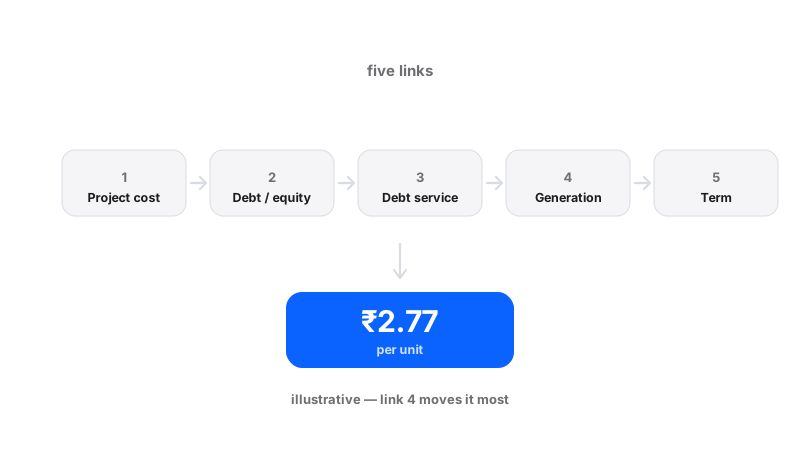
Everyone quotes a tariff. Few write out the chain that produces one. It is five links long, and the assumption that moves it most is not the one people argue about.
A tariff is not an opinion about what the market will bear. It is the output of an arithmetic chain that starts at capital cost and ends at rupees per unit. Writing the chain out once, end to end, is the fastest way to see why two bidders on the same tender can be several percent apart and both be right.
The chain
Five links, in order. Each one takes the previous number and does one thing to it.
| Link | Illustrative value | |
|---|---|---|
| 1 | Project cost — everything capitalised before commissioning. | ₹520 crore |
| 2 | Debt and equity split — how that cost is funded. | 75% / 25% |
| 3 | Debt service — what the loan costs each year, set by rate and tenor. | ₹46.5 crore/yr |
| 4 | Annual generation — the units you actually have to sell. | 245 million units |
| 5 | Term — how long you are selling them for. | 25 years |
Now walk it. Debt of ₹390 crore at around 9% over an 18-year tenor gives roughly ₹46.5 crore of annual debt service. A DSCR covenant of 1.20× means the project must throw off about ₹55.8 crore of cash before debt service to satisfy the lender. Add operating cost of, say, ₹12 crore, and revenue must be around ₹67.8 crore a year. Divide by 245 million units and you get roughly ₹2.77 per unit as the tariff the debt alone requires. Equity return is then priced on top of that, not instead of it.
The link that actually moves it
Here is the part worth internalising. Take the same chain and knock three percent off generation — a difference well inside the gap between a P50 and a P90 case.
| Base | Generation −3% | |
|---|---|---|
| Annual generation | 245 m units | 237.7 m units |
| Revenue required | ₹67.8 cr | ₹67.8 cr |
| Tariff required | ₹2.77 | ₹2.85 |
Three percent off generation puts about eight paise on the tariff. Now do the same to capital cost: three percent off ₹520 crore is ₹15.6 crore, which reduces annual debt service by roughly ₹1.4 crore and takes only about six paise off the tariff.
Why generation beats capex at the margin
Capital cost is diluted twice before it reaches the tariff — once by the debt-equity split, and again by being spread across the tenor. Generation is the denominator of the final division and is not diluted at all. A percent of generation is worth more than a percent of capex, and it is the number people scrutinise least.
About the numbers here
Every figure in this piece is illustrative. They are internally consistent so the arithmetic can be followed end to end, but they are not drawn from any real project, tender or client.
Using the chain
- When a tariff surprises you, walk the five links rather than debating the answer. One of them will be different, and it is usually link 4.
- Ask what generation basis a quoted tariff is on. A tariff built on P50 and one built on P90 are not comparable numbers.
- Sensitise generation before capex. It is the cheaper thing to get wrong to test and the more expensive thing to get wrong in practice.
- Keep the DSCR covenant visible in the chain. It is what turns a financing term into a price.
The last piece in this series steps back from the model entirely, to the document that constrains all of it.