
Insights
A megawatt of solar needs four to five acres.
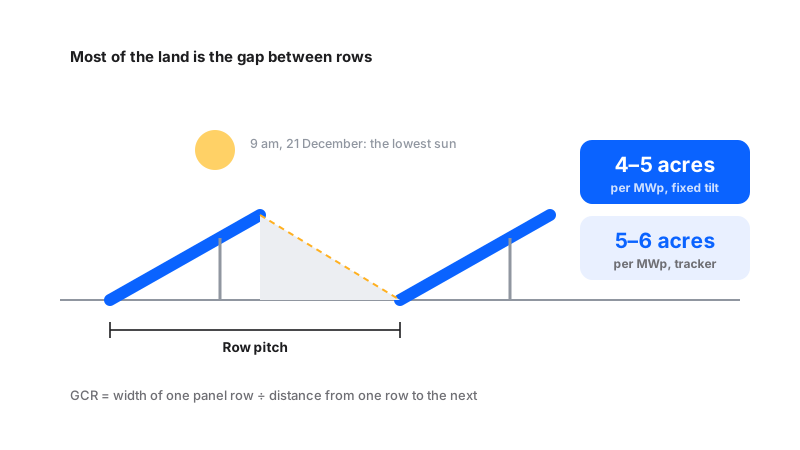
Most of a solar plant’s land is not under panels. It is the gap between the rows, kept wide enough that one row never shades the next. That gap is why a fixed-tilt plant in India needs roughly four to five acres for every megawatt of panels, and why that number is a design choice, not a constant.
Ground coverage ratio
Ground coverage ratio, GCR, compares a row of panels with the ground it occupies:
The definition
GCR = width of one panel row ÷ distance from one row to the next. A GCR of 0.4 means each row’s panel width is 40% of the row-to-row distance; the other 60% is the gap.
Some teams use the panel’s horizontal footprint instead of its tilted width, since a tilted panel covers slightly less ground than its width suggests. Either is fine, as long as everyone in the conversation is using the same one.
Higher GCR packs more panels into less land, but the rows sit closer and shade each other more. Lower GCR wastes less energy to shading and spends more on land, cable and fencing, all of which reach the LCOE. Neither is right in general; the trade is the point.
Why the rows sit so far apart
The spacing is set by the worst sun of the year. Designers typically check the shadow at around 9 am on 21 December, when the sun is at its lowest, and space the rows so the front row’s shadow clears the next row through the main generating hours, even on the shortest day.
The tilt angle sets how tall the row stands, the sun angle sets how long its shadow falls, and the two together set the row pitch. Actual spacing depends on the latitude, the tilt and the design criteria chosen for the site: a plant that accepts a little winter-morning shading can sit tighter than one that accepts none.
Where the acres go
| Layout | Typical land, per MWp |
|---|---|
| Fixed tilt | 4 to 5 acres |
| Single-axis tracker | 5 to 6 acres |
And not all of it is panel rows. The total covers:
- Panel rows and the gaps between them, the largest share by far.
- Internal roads for cleaning and maintenance.
- Inverter and transformer stations.
- The switchyard or pooling substation, sized for the connectivity the project holds.
- Boundary setbacks, drainage and fencing.
At those planning values, a 100 MWp fixed-tilt plant is a 400 to 500 acre parcel before anyone has looked at the actual site: its shape, its slope, its drainage and the land that cannot be used at all.
What changes the number
- Latitude. Further north, the winter sun sits lower, shadows are longer and rows must sit further apart.
- Module efficiency. Higher-wattage modules produce more power from the same area, so newer plants need less land per MWp.
- Trackers. Rows that rotate to follow the sun need wider spacing to avoid shading each other: more land, in exchange for more energy.
- DC/AC ratio. Land is sized on panel capacity in MWp, not on the grid connection. A higher DC/AC ratio puts more MWp, and so more land, behind each MW of connection.
About this piece
Acres per MWp are typical Indian planning values, based on DC panel capacity, and vary with site, design and module choice. Newer high-efficiency modules often need less. The geometry described is illustrative; the actual layout comes from the site survey and the shading criteria chosen for it.
Why this belongs in the model
Land is usually treated as an input: so many acres, so many megawatts. But the two levers that most change acres per MWp, trackers and DC/AC ratio, are exactly the levers a configuration study is trying to set. A tracker buys energy with land; a higher DC/AC ratio buys capacity factor with land. Whether either is worth it depends on what the land costs and what the extra energy is worth against the tender.
Which means the land number belongs inside the comparison, not ahead of it. Size the configuration first (panels, trackers, DC/AC, storage) and let the acres follow, rather than letting an early land estimate quietly decide the configuration for you.
Frequently asked questions
How many acres does 1 MW of solar need?
Roughly 4 to 5 acres per MWp for a fixed-tilt plant in India, and 5 to 6 acres per MWp with single-axis trackers. These are planning values based on DC capacity and vary with site and design.
What is ground coverage ratio (GCR)?
The width of one panel row divided by the distance from one row to the next. A GCR of 0.4 means the panels take 40% of the row pitch and the other 60% is the gap.
Why are solar rows spaced so far apart?
So the front row's shadow clears the next row through the main generating hours on the shortest day of the year. Designers usually check the low winter sun, around 9 am on 21 December.
Why do trackers need more land?
Rows that rotate to follow the sun need wider spacing to avoid shading each other. They buy more energy with more land.
Does the DC/AC ratio change the land needed?
Yes. Land is sized on panel capacity in MWp, so a higher DC/AC ratio puts more MWp, and more acres, behind each MW of grid connection. See a project has a configuration, not a size.
Do newer modules need less land?
Usually. Higher-wattage modules produce more power from the same area, so newer plants often need less land per MWp, which also helps the cost of each unit.