
Insights
100 MWh does not deliver 100 MWh.
Every battery energy storage system is described by two numbers, its power in MW and its energy in MWh, and neither of them tells you how much energy actually reaches the grid. Between the nameplate and the meter sits a list of losses, limits and guarantees, each with its own term. Get the terms right and the gap stops being a surprise.
The two numbers on every BESS
| Number | What it means |
|---|---|
| MW: power | How fast the battery can charge or discharge. |
| MWh: energy | How much it can store. |
| Duration | MWh ÷ MW, in hours. |
| C-rate | MW ÷ MWh. The inverse of duration. |
So a 125 MW / 500 MWh system is a 4-hour system, or 0.25C. A 1,000 MW / 2,000 MWh system is a 2-hour system, or 0.5C. The same MWh can be a short, powerful battery or a long, gentle one (one of the six numbers of a configuration), and the two are built, and priced, quite differently.
Where the megawatt-hours go
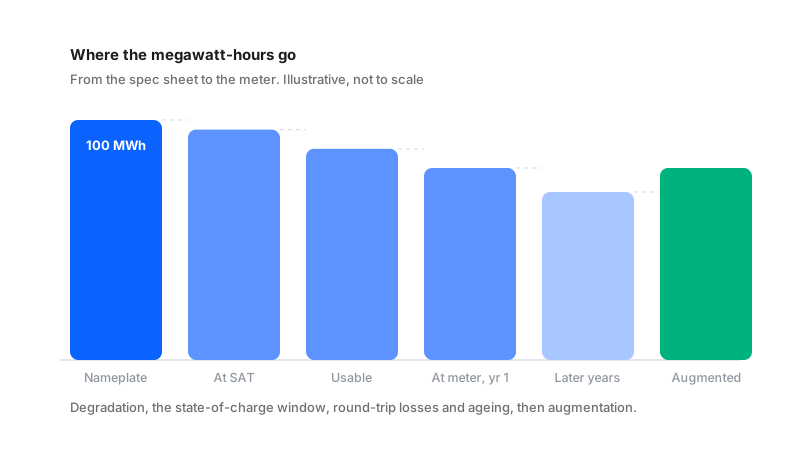
Follow 100 MWh of nameplate energy from the spec sheet to the meter and it shrinks at every step:
- Factory to site. Some degradation happens between the factory acceptance test (FAT) and the site acceptance test (SAT). Energy at SAT is the capacity actually handed over.
- The state-of-charge window. The battery is not run from completely full to completely empty, to protect cell life. Usable energy in the battery is what sits inside that window.
- Round-trip efficiency. Energy is lost converting and storing it: charging, holding and discharging, through the inverters and transformers. What arrives at the meter in year 1 is less again.
- State of health. Capacity fades with cycling and with age, so the energy delivered in later years is lower than in year 1.
- Augmentation. Modules are added over the project life to restore capacity lost to degradation, which is how a contract that guarantees a capacity for fifteen years is actually met.
The practical consequence
A tender that asks for 100 MWh at the meter needs more than 100 MWh of cells on day one, and more again by year ten. How much more is the sum of every step above, and every one of them is a number someone has to commit to in the contract.
Seven terms in every BESS contract
| Term | What it means |
|---|---|
| State of Charge (SoC) | How full the battery is right now, as a percentage of its capacity. |
| Depth of Discharge (DoD) | How much of the capacity is used in one cycle. Deeper cycles wear cells faster. |
| Round-trip efficiency (RTE) | Energy out as a share of energy in. Indian tenders typically require at least 85%, measured AC to AC. |
| Usable capacity | Energy actually delivered at the grid meter, AC, in one full discharge within the allowed SoC window. Guarantees and liquidated damages are measured against it. |
| State of Health (SoH) | Remaining capacity compared with when the battery was new. |
| Augmentation | Adding battery modules over the project life to make up for capacity lost to degradation. |
| Availability | Share of time the system is ready to charge and discharge on demand (not the same as output). Indian tenders typically require at least 95% a year. |
How a BESS is built
Cells are packed into modules; modules are stacked into racks with monitoring; racks go into containers with cooling and fire safety. The power conversion system (PCS) converts DC from the battery to AC for the grid, and a transformer steps the voltage up to connect to the network.
The conversion from DC to AC and back is where part of the efficiency loss happens, which is why round-trip efficiency is measured AC to AC, at the point the grid sees, and not on the cells.
About this piece
A glossary of the mechanics, written for people sizing and pricing projects. Tender figures refer to recent Indian standalone BESS tenders; check the specific Request for Selection for exact terms. The sequence of losses is illustrative and not to scale.
Why this belongs in the model
Every term on this page is a parameter, and most of them interact. The SoC window and the DoD set how much of the nameplate is usable; round-trip efficiency sets how much solar has to be stored to deliver a unit at night; state of health sets how that changes every year; augmentation sets what it costs to hold the line.
Sizing a battery for firm or peak power on its nameplate MWh and checking it against the tender afterwards gets the order of operations backwards. Start from what has to reach the meter, hour by hour, in year 15 as well as year 1, and let the model work out how much battery that takes, and when the next augmentation is due.
Frequently asked questions
What is the difference between MW and MWh in a battery?
MW is power: how fast the battery can charge or discharge. MWh is energy: how much it can store. Duration is MWh divided by MW, so a 125 MW / 500 MWh system is a 4-hour system.
What is C-rate?
MW divided by MWh, the inverse of duration. A 4-hour battery is 0.25C and a 2-hour battery is 0.5C.
Why does a 100 MWh battery not deliver 100 MWh?
Energy is lost between the factory and site tests, the state-of-charge window keeps the battery away from completely full and empty, conversion losses reduce what reaches the meter, and capacity fades with cycling and age.
What round-trip efficiency do Indian tenders require?
Typically at least 85%, measured AC to AC at the grid meter. Check the specific Request for Selection for the exact figure.
What is battery augmentation?
Adding battery modules over the project life to make up for capacity lost to degradation, so a guaranteed capacity can be held for the whole contract.
How should a battery be sized for a tender?
From what has to reach the meter, hour by hour, in later years as well as year one. Start from the obligation, not the nameplate; see 100 MW of firm power needs about 300 MW built.