Insights
Most of a solar unit’s cost is the money.
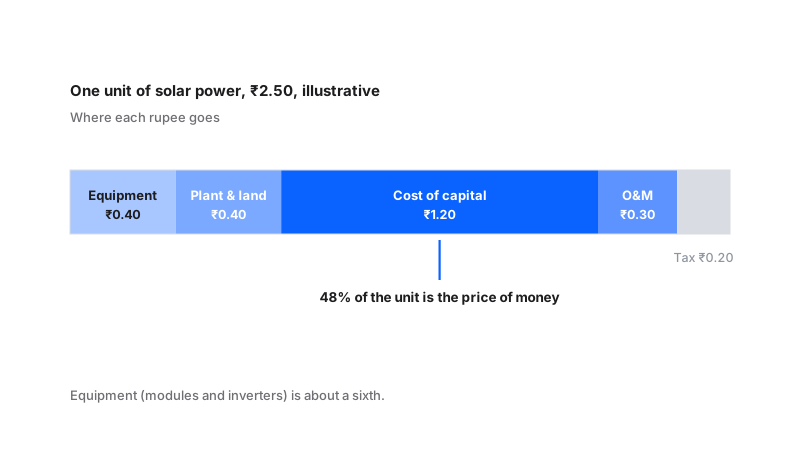
Ask what a unit of solar power costs and most people think of modules. They are a sixth of it. The largest single share of a solar unit is not equipment at all. It is interest on the debt and the return the equity expects. Solar is a capital-heavy business with no fuel bill, so the price of money is the price of power.
The Levelised Cost of Electricity, LCOE, is the number that makes this visible. It is the average cost of producing one unit over the plant’s entire life, with every rupee of building and running it spread across every unit it will ever generate.
What it is
The definition
LCOE (₹ per kWh) = lifetime cost of the plant ÷ lifetime energy generated, with both the top and the bottom discounted to present value, because a rupee spent now is worth more than a rupee spent in year 20, and a unit generated now is worth more than one generated then.
The discounting is not a detail, and it is why the generation basis matters as much as the cost. Leave it out and a plant that front-loads its spending looks exactly as cheap as one that spreads it, which it is not. Put it in and the cost of capital enters the number twice: once as the interest and equity return the project pays, and again as the rate at which future units are worth less.
What makes up one unit
An illustrative breakdown of a ₹2.50 unit of utility-scale solar:
| Component | ₹/kWh | Share | What it is |
|---|---|---|---|
| Equipment | 0.40 | 16% | Modules and inverters. |
| Plant, land and evacuation | 0.40 | 16% | Structures, civil works, cabling, land and the line to the grid. |
| Cost of capital | 1.20 | 48% | Interest on debt and the return to equity investors. |
| Operation and maintenance | 0.30 | 12% | Cleaning, repairs, insurance and staff. |
| Taxes and others | 0.20 | 8% | Corporate tax, scheduling and other charges. |
| Total | 2.50 | 100% |
Read the table the other way round and it says something uncomfortable about where negotiating effort usually goes. A hard-won 10% off the equipment bill moves the unit by about four paise. A one-point change in the cost of capital moves it by far more than that, and nobody had to haggle over a container of panels to get it.
What moves the number
- Sunshine and CUF. More generation from the same plant spreads the same cost over more units. Higher CUF, lower LCOE, which is why a better site, a tracker or a higher DC/AC ratio can pay for itself.
- Cost of capital. The biggest single lever. Cheaper debt, a longer tenor and lower equity return expectations pull LCOE down sharply, and the effect compounds over a 25-year life.
- Capex. Module and equipment prices set the upfront bill. Lower capex, lower LCOE, and less money to borrow, which helps twice.
- Degradation and plant life. Slower output decline and a longer operating life mean more lifetime units over which to spread the cost. Both lower LCOE.
LCOE is not the whole story
Three numbers get used as if they were the same thing, and they are not.
| Number | What it is |
|---|---|
| LCOE | What a unit costs the generator to produce. |
| Tariff | The price agreed in the power purchase agreement, usually set by competitive bidding. It can sit above or below LCOE, depending on risk and bid strategy. |
| Landed cost | What the buyer actually pays at their meter, after wheeling, surcharges and other charges. |
And LCOE says nothing about when power is produced. A cheap unit at noon is not the same as a unit at 8 pm. Firm and evening power costs more because it needs storage, and a project priced on the LCOE of its solar alone has quietly left out the expensive part of what the buyer asked for.
About this piece
An explanation of the arithmetic, written for people sizing and pricing projects. The ₹2.50 breakdown is illustrative; real numbers depend on site, technology, financing and the year of the bid. For how the components chain together into a quoted tariff, see How a tariff is built.
Why this belongs in the model
LCOE is easy to compute and easy to misuse. The single number hides the two things a bid actually turns on: the financing assumptions behind it, and the shape of the generation it is spread across.
Both are modelling questions. A tariff for round-the-clock or peak power is not solar LCOE plus a margin; it is the cost of the whole configuration (solar, wind, storage and the penalty exposure that comes with each) divided by the units that actually meet the obligation, hour by hour. The useful number is not the cheapest unit the plant can make. It is the cheapest unit that delivers what the contract asks for.
Frequently asked questions
What is LCOE?
The Levelised Cost of Electricity: the average cost of producing one unit over a plant's whole life, calculated as lifetime cost divided by lifetime energy, both discounted to present value.
What is the biggest part of the cost of solar power?
The cost of capital. In the illustrative ₹2.50 unit it is ₹1.20, or 48%, against ₹0.40 for modules and inverters.
Why is LCOE discounted?
Because a rupee spent now is worth more than one spent in year 20, and a unit generated now is worth more than one generated later. Without discounting, a plant that spends early looks as cheap as one that spreads its spending.
What lowers LCOE the most?
Cheaper capital first, then higher CUF, lower capex, slower degradation and a longer life. A better site, a tracker or a higher DC/AC ratio raise CUF; see what they cost in land.
Is LCOE the same as the tariff?
No. LCOE is what a unit costs to produce; the tariff is the price agreed in the PPA; the landed cost is what the buyer pays at the meter after charges. See how a tariff is built.
Why doesn't LCOE tell the whole story for firm power?
It says nothing about when power is produced. Evening and round-the-clock power needs storage, so it costs more per unit than daytime solar. See the language of battery storage.