Insights
What the draft Grid Code amendment changes.
CERC has proposed a second amendment to the Indian Electricity Grid Code, 2023. It touches three things a developer lives with every day: how a plant gets from trial run to commercial operation, how late a schedule can still change, and what happens when a payment is missed. It is a draft, but drafts tend to tell you where the rules are going.
Status
Draft notification dated 21 September 2026. Not yet in force. As proposed, phase one takes effect on publication in the Gazette, and phase two from 1 April 2027. Draft provisions may change in the final regulations.
From trial run to COD
| Stage | What the draft proposes |
|---|---|
| Trial run | Notice reduced from seven days to three. Projects above 50 MW but below 250 MW must first trial at least 50 MW, with the balance in up to three instalments. Projects of 250 MW or more can trial in instalments of at least 50 MW, with no limit on the number. Standalone storage follows the same pattern, with later instalments of at least 5 MW. |
| Infirm power | Scheduled only after a certificate of successful trial run. If the contract is silent, it is first offered to the contracted buyer, directly or through the implementing agency, with at least seven days’ notice; no response means it can be sold to a third party. Renewable generating stations and energy storage get a 45-day initial period, which the RLDC may extend by up to three months in total, on a request made at least 10 days before the proposed extension. |
| COD | Declared for Grid Code purposes after a successful trial run. Any extra conditions in the power purchase agreement (see reading a tender) must still be met before supply under it. |
| Rated capacity | If transmission constraints block its demonstration within a year of COD, the window becomes one year from GNA effectiveness or COD, whichever is later. |
The instalment rules matter more than they look. A large plant that can commission in 50 MW blocks starts earning on its first blocks while the rest is still being built, and the infirm-power rules decide who buys those early units and at what notice.
Grid discipline
Congestion charge
- A new regime within the Grid Code, replacing the 2009 congestion regulations. The old rate applies until CERC notifies a new one.
- Paid by regional entities adding to congestion, and received by those relieving it, on top of deviation charges.
- Two time blocks of notice. Payable within 10 days, with 0.04% daily interest if late. It sits alongside the grid instructions a plant already lives with.
Access cut for unpaid dues
- Covers unpaid deviation, congestion and reactive energy charges, or unreplenished payment security.
- Triggered 75 days after the RPC account, or the next bank working day after a missed payment-security top-up.
- Short-term access, including exchange trades, is cut entirely. Longer contracts are reduced by an extra 5% for each month of default.
- Restored within one day of payment.
The part worth reading twice
Losing short-term access means losing the exchange, which, for a merchant or partly merchant project, is the revenue. A payment-security top-up missed by a day becomes a market problem, not just an accounts one.
Market timelines in two phases
| Today | Phase one, on notification | Phase two, from 1 April 2027 | |
|---|---|---|---|
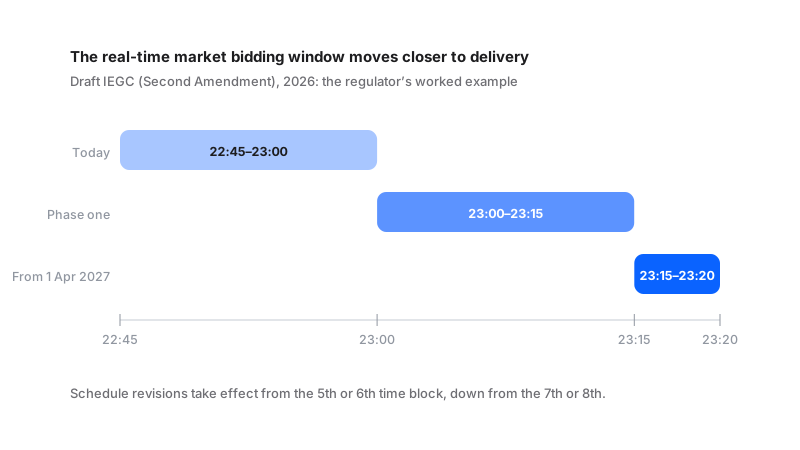
| Real-time market bidding window | 22:45 to 23:00 | 23:00 to 23:15 | 23:15 to 23:20 |
| Schedule revision takes effect from | 7th or 8th time block | 7th or 6th time block | 5th or 6th time block |
Bidding window times are the regulator’s worked example; revisions count the block of the request as the first. The direction is the point: bidding closes closer to delivery, and revisions take effect sooner. For a variable plant that is good news (a forecast made closer to the hour is a better forecast), but only for whoever is set up to use the shorter window.
Also in the draft
- Peak declared capacity. Thermal stations cannot declare lower capacity in peak hours than off-peak, except during outages.
- SCUC and unit shutdown. Timelines are revised, and NLDC may run security-constrained unit commitment at any time of day to commit or decommit units.
- Pumped storage COD. The last unit’s COD becomes the plant’s COD.
About this piece
A summary of proposed changes, written for people sizing and pricing projects. It is drawn from CERC draft notification No. L-1/265/2022/CERC dated 21 September 2026, Indian Electricity Grid Code (Second Amendment) Regulations, 2026. It is not legal advice, the provisions are not yet in force, and the final regulations may differ.
Why this belongs in the model
Two of these changes reach straight into a project model. Commissioning in instalments changes the revenue curve of the first year, much as milestone extension charges changed the cost of delay: energy starts flowing from the first 50 MW block, and the question of who buys infirm power, at what price, decides whether those early units are worth anything. And a real-time window that closes closer to delivery changes how much a forecast error costs, which is the whole economics of deviation for a solar or wind plant.
Neither shows up in an annual-average spreadsheet. Both show up the moment the year is simulated block by block, which is where a draft like this is best read: not as a list of rules, but as a list of the assumptions it is about to change.
Frequently asked questions
Is the second Grid Code amendment in force?
No. It is a draft notification dated 21 September 2026. As proposed, phase one takes effect on publication in the Gazette and phase two from 1 April 2027, and the final regulations may differ.
What changes for trial runs?
The notice drops from seven days to three. Projects above 50 MW but below 250 MW must first trial at least 50 MW, with the balance in up to three instalments; projects of 250 MW or more can trial in instalments of at least 50 MW with no limit on the number.
Who gets infirm power from a new plant?
If the contract is silent, it is first offered to the contracted buyer, directly or through the implementing agency, with at least seven days' notice. With no response it can be sold to a third party.
What is the new congestion charge?
A regime within the Grid Code that replaces the 2009 congestion regulations. Entities adding to congestion pay it and those relieving it receive it, on top of deviation charges, with two time blocks of notice and payment within 10 days.
What happens if payment security is not topped up?
Short-term access, including exchange trades, is cut entirely, and longer contracts are reduced by an extra 5% for each month of default. Access is restored within one day of payment.
How do the real-time market timelines change?
The bidding window moves from 22:45 to 23:00 today, to 23:00 to 23:15 in phase one, and 23:15 to 23:20 from 1 April 2027. Schedule revisions take effect from the 5th or 6th time block instead of the 7th or 8th. For how this reaches a model, see P50 and P90.